A tool that answers it in about a minute: the metal at the spot price of that moment, the stones at wholesale, and the five numbers the same piece is honestly worth depending on who is buying.
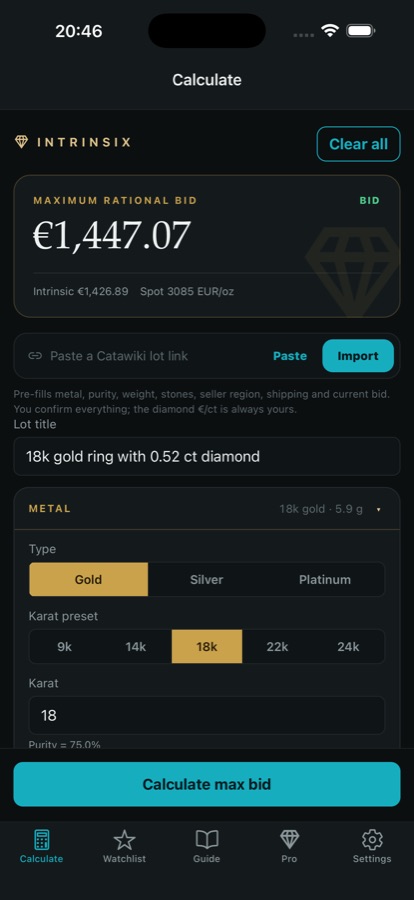
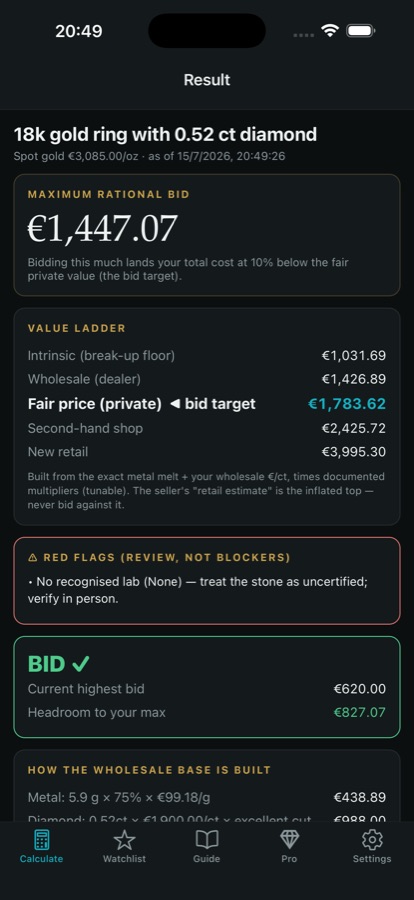
18k ring, 5.9 g net, 0.52 ct · worked example
The problem
A customer arrives with a figure in their head. It came from an insurance valuation, a shop window, or an aunt. It is almost never the number you are about to say out loud, and the next ten minutes go on explaining why.
The arithmetic underneath is not hard. It is just tedious, and three things go wrong in it every week.
Gross weight is not gold weight. A 12 g ring with stones can hold 5 g of metal.
Carat weight alone says nothing. A 1 ct diamond runs from about €700 to €12,000.
Treatment collapses value. A glass-filled ruby is worth less than the gold around it.
Lab-grown is everywhere. Chemically identical, and 10 to 20 % of the price.
How it works
Metal, hallmark, net weight without the stones. Stones by carat, natural or lab-grown. Loose stones with no metal at all are fine.
The metal spot price is fetched live and refreshes on its own. Stone prices come from a wholesale matrix, and you can override any of it by hand.
Five values side by side, from melt floor to new retail, so the difference you are explaining to a customer is on the screen instead of in your head.
Buying at auction
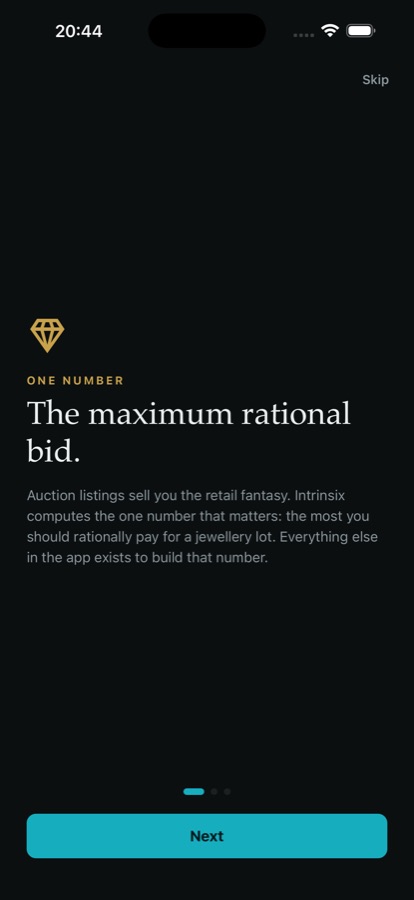
If you buy stock at auction, the app adds what the listing leaves out and returns the maximum you should bid, not the maximum you could.
Paste an auction lot link and the specifications are extracted for you; you confirm every value before it counts. On a €1,000 hammer, buying inside the EU:
| Line | Typical |
|---|---|
| Hammer | € 1,000 |
| Buyer's premium, 9 to 25 % | +€ 90 to 250 |
| VAT on the premium | +21 % of that |
| Shipping and insurance | +€ 15 to 60 |
| From outside the EU: import VAT and duty | +21 % and up |
| Landed, non-EU seller | +35 to 45 % |
What it costs
Nothing is sold on the free tier and there is no advertising anywhere in the app. If the counter side of the work is all you need, you never pay.
For your website
One line of HTML puts an embeddable version on your site: your shop name above it, your accent colour, prices refreshing themselves every five minutes.
Free, for any shop, now and later. The only condition is the credit line underneath. That is the entire deal.
A customer who has already seen a realistic number arrives ready to talk, instead of arriving with a figure that came from nowhere.
Where it helps, and where it does not
Metal at the live spot price, any purity, net of the stones.
Brand premiums. A signed piece is worth more than its parts, and the app does not know by how much.
Diamonds by the four Cs, natural and lab-grown, at wholesale per carat.
Old cuts and antique work. No modern grade describes them properly.
All auction costs: premium, VAT on the premium, import VAT and duty, shipping.
Detecting treatment. It prices what you tell it the stone is.
Loose stones with no metal, and scrap with no stones.
Replacing a valuer. It is the arithmetic under the judgement, not the judgement.
That is the only test worth running: put something through it where you already know what you paid, and see whether the number holds.